

GI Chronicle #03 | Kannadippaya: Kerala’s Traditional Bamboo Mat
Prepared by IP DXTR | Geographical Indication Deep-Dive Series
Kannadippaya (Bamboo Mat), also known as the Bamboo Mirror Mat, is a registered Geographical Indication associated with the high forests of Kerala. Known for its mirror-like finish and intricate geometric designs, the mat produced there by tribal communities offers an interesting example of how geography, craftsmanship and community come together in a GI-protected product.
Summary Profile:
Registered Proprietors | Unarvu Pattikavargha Vividodesha Sahakarana Sangam and Vanasree Bamboo Craft & Vanavibhava Shekarana Unit |
Class of Goods | Classes 20 and 27 |
Geographical Area | Idukki, Ernakulam, Thrissur, Palakkad and Pathanamthitta districts, Kerala |
What is Kannadippaya?
Kannadippaya is a bamboo mat woven from reed bamboo by tribal communities in the high forests of Kerala. It is distinguished by its smooth, reflective surface and its geometric motifs.
The Meaning of the Name “Kannadippaya”
Registered as Kannadippaya (Bamboo Mat) and also rendered in English as the Bamboo Mirror Mat, the name points to the mirror-like quality of the finished surface. Local folklore adds a story to it: a tribal king is said to have gifted a finely woven mat to a visiting king, and it was so exquisite that it was compared to a mirror. This is local tradition and not documented history.
Uniqueness of Kannadippaya GI
The distinguishing character of Kannadippaya rests on exceptionally thin bamboo slivers and a weaving technique that produces a smooth, reflective surface.
This gives rise to three defining qualities:
Mirror-like finish: a specific weaving technique creates a smooth, reflective surface, which gives the mat its name.
Exceptionally fine slivers: the mat is built from very thin slivers cut from reed bamboo culms.
A family and community craft: the tools used to make the slivers are traditionally distributed equally among family members, and the weavers are drawn from tribal communities, particularly the Muthuvan and Urali.
Specifications
Material
The mat is woven from reed bamboo found in the Western Ghats, chiefly Teinostachyum wightii and Ochlandra travancorica. Weavers distinguish local varieties known as Ponnu, Kattu and Pottu, and Ponnu (golden) is the most preferred for high-quality weaving.
Design
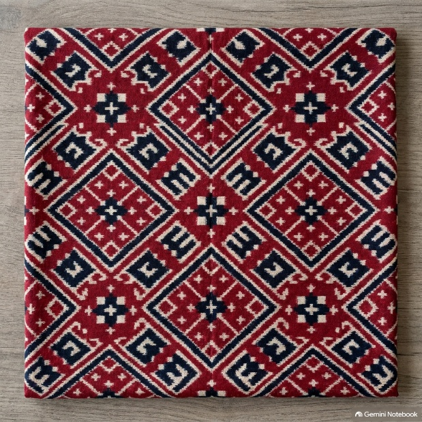
Recognised designs are Ottakannan (also known as Anachevidan), Randu Vari, Nalu Vari and Nandu Paya.
Characteristics
The mat has a smooth, reflective, mirror-like surface, achieved through exceptionally thin slivers and a specific weaving technique.
Uses
The traditional mat remains the centrepiece. The Kannadippaya design is now also applied to baskets, folders and file covers, bags and pouches, and laptop sleeves, to enhance marketability.
Design Elements
The craft is defined by geometric motifs, set against the smooth, reflective surface that the weave produces. Four designs are recognised: Ottakannan (Anachevidan), Randu Vari, Nalu Vari and Nandu Paya. The same design is now carried onto contemporary products, which extends the pattern beyond the mat itself.
Geographical Area of Production
Production is restricted to five districts of Kerala: Idukki, Ernakulam, Thrissur, Palakkad and Pathanamthitta. Idukki is the primary hub, with settlements such as Edamalakkudy and Uppukunnu among its centres of production. These districts provide the climatic conditions and access to the bamboo species the craft requires. The Register entry carries a map showing the area of production.
Method of Production
Production follows three broad stages:
Stage 1: Sourcing the reed
Reed bamboo of the two principal species is gathered from the Western Ghats, with the Ponnu variety preferred for high-quality work.
Stage 2: Preparing the slivers
The culms are worked into exceptionally thin slivers. The tools used for this are traditionally distributed equally among family members.
Stage 3: Weaving
The slivers are woven using a specific technique that creates the smooth, reflective surface from which the mat takes its name, in the recognised geometric designs.
Proof of Origin
Two published ethnographic sources document reed mat weaving among Kerala’s tribal communities. L.A. Krishna Iyer, in The Travancore Tribes and Castes (1939), records that Muthuvans living in the high forests make mats, baskets and sieves from reed (Ochlandra travancorica) and sell them to people of the plains, work traditionally done by women. U.R. Ehrenfels, in Kadar of Cochin (1952), documents the collection of pai (bamboo mats) from the jungle, made by women and sold on the plains by male family members. These sources speak to reed mat weaving among tribal populations generally.
The account of the mirror mat’s naming rests on local tradition, namely the folklore of the tribal king’s gift described above and is not documented history.
Inspection Body
The registered proprietors, together with the Government of Kerala and the KSCSTE Kerala Forest Research Institute (KFRI), Peechi, are in the process of establishing a certification system to verify genuine Kannadippaya and prevent the sale of inferior substitutes. KFRI is designated to help install an effective inspection structure.
Registration Status
Kannadippaya is now a registered Geographical Indication. The Geographical Indications Registry in Chennai registered it under GI Application No. 927 as of 19 July 2022, under section 16(2) of the Geographical Indication of Goods (Registration and Protection) Act, 1999, and issued Certificate No. 695, sealed on 31 March 2025.
The registration is for “Kannadippaya (Bamboo Mat)” in respect of Kannadi, falling in Classes 20 and 27, and the entry has been made in Part A of the Register.
The registered proprietors are two bodies from Idukki district: Unarvu Pattikavargha Vividodesha Sahakarana Sangam, based at Venmani, Palaplavu, and the Vanasree Bamboo Craft & Vanavibhava Shekarana Unit, based at Moolakkad, Uppukunnu.
The registration was facilitated by the KSCSTE Kerala Forest Research Institute.
About GI Chronicle
GI Chronicle is IP DXTR’s ongoing series exploring India’s Geographical Indications through individual products, their history, geographical roots, traditional knowledge and distinctive characteristics.


I have to admit, I never quite imagined that a bamboo mat could have a GI tag! Kannadippaya from Kerala is quite fascinating. It is wonderful to see such traditional crafts getting recognition and protection. Glad I came across this one. A very interesting read!